3DCP Group delivers 36-apartment printed student village in Holstebro at €1,880 per sq m
Denmark's 3DCP Group has completed Skovsporet, Europe's largest 3D-printed housing project - 36 student apartments in Holstebro built at €1,880 per sq m with a three-person crew.
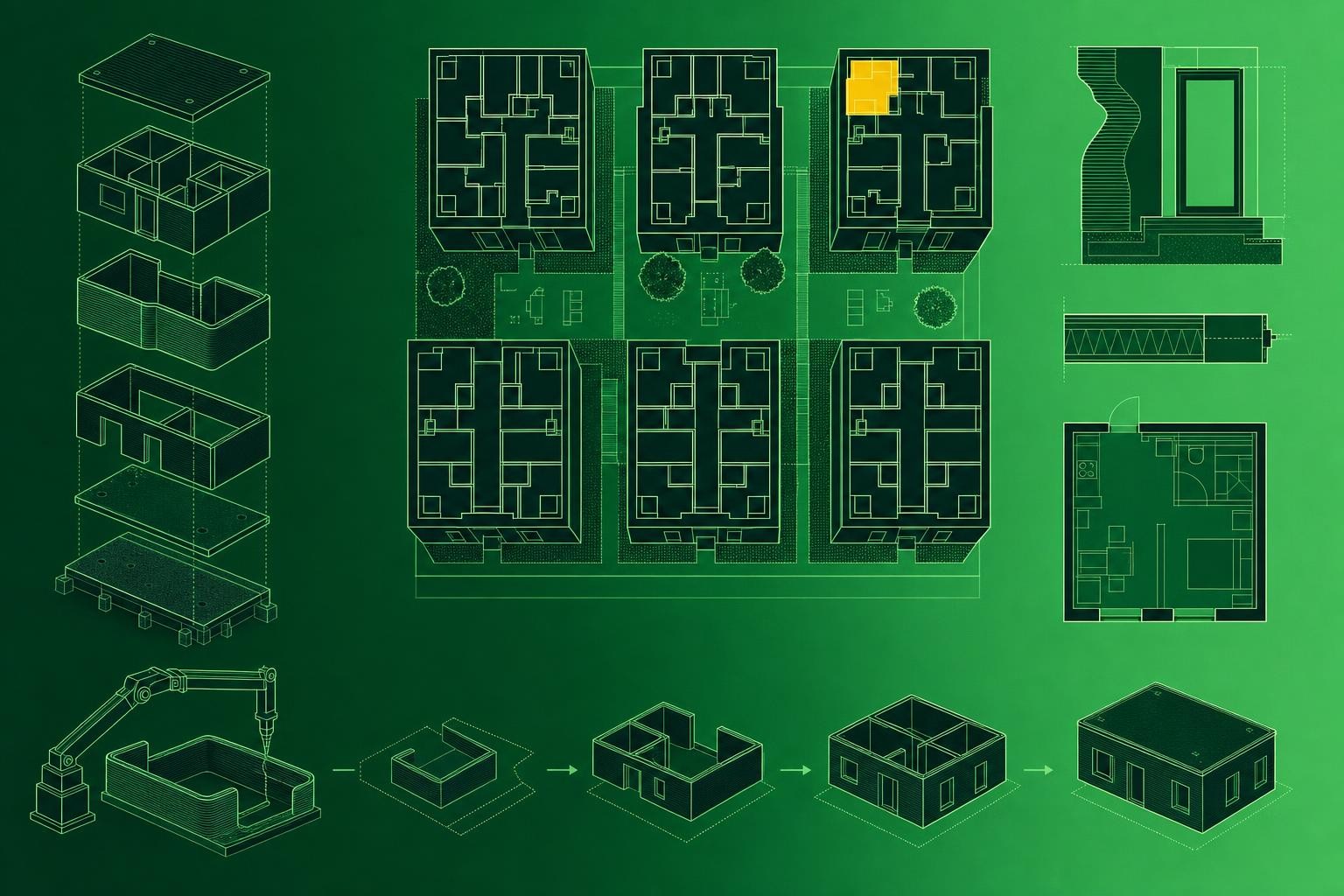
Students have begun moving into Skovsporet, a 36-apartment development in Holstebro, Denmark that 3DCP Group and affordable housing organisation NordVestBO describe as Europe's largest 3D-printed housing project[1]. The six-building cluster covers 1,650 sq m in total and was delivered at €1,880 per sq m for the building works - below Denmark's statutory budget ceiling for subsidised housing[1].
What was built
Skovsporet - Danish for "The Forest Trail" - comprises six single-storey clusters of six apartments each, arranged around shared courtyards and landscaped gardens[1]. Individual units range from 38 sq m to 50 sq m and are fully self-contained, with a kitchen, study area, lounge, bathroom, and sleeping area[1]. The project sits adjacent to VIA University College and was developed by NordVestBO, a Western Denmark housing association that manages approximately 3,300 homes.
The project team included:
- Contractor: 3DCP Group (turnkey, concrete printing)
- Printer: COBOD BOD3 gantry printer
- Developer: NordVestBO
- Architects: SAGA Space Architects with MS+
How the printing was executed
All structural walls were printed on site using a COBOD BOD3 printer operated by a three-person crew[1]. The pace improved markedly across the six buildings: printing time for the final building fell to five working days, down from several weeks on the first[1]. That trajectory - more than one apartment per day by the end - reflects the efficiency gains that come from repeating a digital production process at scale rather than retooling for each unit.
The concrete mix used D.fab material incorporating FUTURECEM, a low-carbon cement developed by Aalborg Portland that emits up to 30% less CO₂ than conventional cement in production[1]. For the site's bicycle shed, 3DCP Group went further, using MEVOcem - a cement-free 3D-printed material that achieves an 84% reduction in CO₂ emissions compared with traditional concrete. Print beds were positioned to work around existing trees, with only 10% of trees on the site removed[1].
Why the cost figure matters
Skovsporet is not a prototype or a landmark commission. It was procured within the same regulated financial framework that governs conventional subsidised housing in Denmark, and the €1,880 per sq m building cost - excluding design, engineering, utility connections, and landscaping - came in under the statutory cap[1]. That distinction separates it from most 3D-printed construction to date, which has tended to be demonstration-led rather than budget-constrained.
The project's origins trace to 2021, when 3DCP Group printed House 1.0 - a prototype - on the same Holstebro site as a precursor to Skovsporet[1]. The full development took approximately one year to complete.
What comes next
3DCP Group and SAGA Space Architects are already trialling new material mixes and production methods for future projects, treating Skovsporet as a baseline rather than a ceiling. The more immediate question for the sector is whether the cost and crew-size figures - a three-person team, sub-cap pricing, six buildings - can be replicated on projects without the benefit of a four-year design-to-delivery runway and a bespoke prototype phase on the same land.
Written by Construction Trade News's automated desk from the sources above and reviewed before publication. How we work.
Related
CASE adds three D Series 3-ton mini excavators with zero tailswing and load-sensing hydraulics
CASE Construction Equipment launched the CX30D, CX34D and CX38D on 17 June 2026, filling the 3-ton class with zero-tailswing machines powered by a 24.4 hp Kubota engine.
10 Sept 2026 News
NewsSimplar Foundation study finds multiskilled U.S. construction crews cut idle time by 68% and post safety rates 57% below industry average
A first-ever national field study on multiskilling in U.S. construction finds a 39% jump in productive crew time and a total recordable incident rate 57% below the industry benchmark.
10 Sept 2026 Codes
CodesOakland adopts 2025 California Building Standards Code with FlexPath and Electric Readiness amendments, effective 1 January 2026
Oakland's 2025 Title 24 adoption - with FlexPath and Electric Readiness reach codes - took effect 1 January 2026, and AB 130 locks in residential standards until 1 June 2031.
10 Sept 2026